DVFriends Custom-Built Morphology Curriculum
For students who learn differently, vocabulary can be about much more than memorizing definitions. Understanding how words are built can give students a powerful tool for unlocking unfamiliar language across everything they study. That’s the thinking behind a new morphology curriculum developed by DVFriends’ upper school language arts team* for students in grades 9–11.
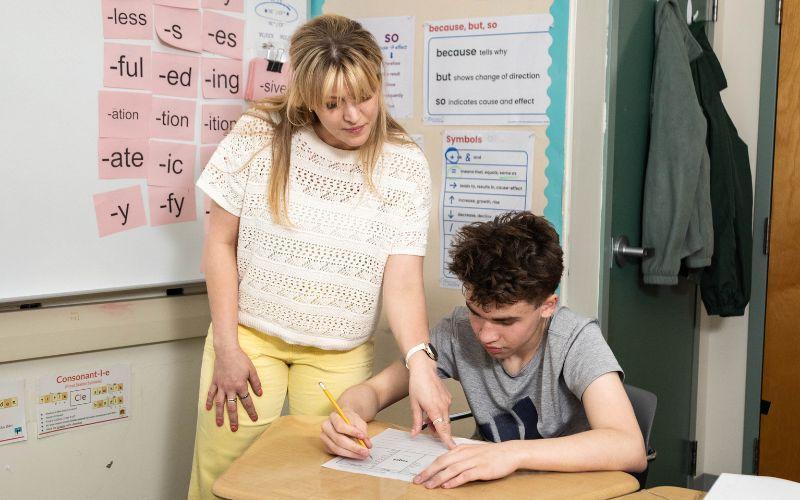
Morphology, the study of the meaningful parts of words, including roots, prefixes, and suffixes, is not new. What is new is a curriculum designed specifically for DV students and the academic work they are doing.
Over the past two years, DV’s Director of Teaching and Learning and language arts teachers have worked together to develop the curriculum, which they are piloting this year. While morphology was already part of their individual teaching, the team saw an opportunity to create a more intentional, consistent approach across the upper school.
Most existing morphology resources are designed for younger students and don’t reflect the reality of DV’s upper school learners. Our students may have underlying language-based learning challenges, but they are also taking grade-level courses in English, science, social studies, and other disciplines where they encounter increasingly complex academic vocabulary every day.
So the team built what they couldn’t find.
That kind of curriculum development isn’t new at DV. Our Adolescent Literacy program grew from a similar need to adapt established literacy approaches for older students when existing resources were largely designed for younger learners. In both cases, our teachers brought together their expertise in language instruction, their knowledge of adolescent learners, and their deep understanding of DV students to create something more responsive to what students actually need.
"We had been adapting materials that weren't designed for our students, so we decided to build something specifically for them,” commented Colleen Chapman, Upper School Language Arts Teacher. “When a student can break a word like 'photosynthesis' into pieces, the word stops being a wall. They have a way in, and that confidence carries into every class."
For the new morphology curriculum, the development team selected the master list of roots students will learn and intentionally assigned them across grades 9–11, considering both the progression of students’ language skills and what they are studying elsewhere. Ninth-grade language arts, for example, introduces roots that connect with vocabulary students are likely to encounter in Integrated Science. Other roots are deliberately introduced later, when students are better prepared to decode and pronounce more complex word structures.
The goal isn’t simply for students to memorize a list of roots. It is for them to recognize those roots when they encounter unfamiliar words, think critically about how a word is constructed, and use what they know to make meaning, whether that word appears in Language Arts, a science lab, a history reading, or somewhere else entirely.
The coordinated curriculum also creates continuity. Teachers develop and share materials, know what students learned in previous years, and can intentionally build on that knowledge as students move through the upper school. The middle school morphology curriculum (grades 6-8) is currently based on the program MegaWords, but they will be building a companion scope and sequence that matches with the upper school program.
It’s a distinctly DV approach: understanding how our students learn, recognizing when existing resources don’t quite meet their needs, and having teachers with the expertise and creativity to build something that does.
*Inspired by the work of Neil Ramsden, Pete Bowers, and Susan Ebbers // Using strategies from older research-based programs like "MegaWords," "Spelling with Morphographs," "Morpheme Magic," and "Dynamic Roots.
If you are unsure if DVFriends serves your student's learning profile, please contact the Admissions Office to speak to Jim Miller or Kavitha Patel.


Kavitha Patel
Assistant Director of Admissions, Director of Financial Aid
(610) 640-4150 x2120
Assistant Director of Admissions, Director of Financial Aid
(610) 640-4150 x2120